

Why EV Owners Should Know Their Vehicle’s Towing Requirements
Introduction
Electric vehicles have changed the way people think about driving, charging, maintenance, and even roadside emergencies. An EV may look similar to a gasoline-powered car from the outside, but its towing requirements can be very different.
One of the biggest mistakes an EV owner can make is assuming that any tow truck or towing method will work. Some electric vehicles can be damaged if they are towed with their drive wheels rolling on the road. Others may require a flatbed, wheel dollies, or specific procedures outlined by the manufacturer.
This matters even more during an unexpected breakdown. A dead 12-volt battery, flat tire, collision, charging problem, or high-voltage system fault can leave an EV owner needing assistance quickly. Knowing what information you should give a towing company when you call and how your vehicle should be transported before an emergency happens can help you avoid unnecessary damage and make the roadside situation easier to manage.
For EV owners looking for how to choose a towing company in the DFW Metroplex, understanding electric vehicle towing requirements is especially useful. Busy highways, long commutes, extreme summer temperatures, and heavy traffic can turn a minor vehicle problem into a stressful roadside situation.
This guide explains what EV owners should know about towing for electric vehicles, why manufacturer instructions matter, which towing methods may be appropriate, and what information you should give a towing provider before your vehicle is moved.
Why EV Towing Is Different From Traditional Vehicle Towing
Traditional gasoline-powered vehicles and electric vehicles use different drivetrains, braking systems, and electrical components. That difference affects how a disabled vehicle should be moved.
Many EVs use electric motors connected directly to the drive wheels. If those wheels rotate while the vehicle is being towed improperly, the motor and related drivetrain components may be affected. Some models also have regenerative braking systems and other electronic components that make manufacturer-specific towing procedures especially important.
That does not mean every EV must always be transported in exactly the same way. Choosing the right towing service based on your vehicle and situation depends on the vehicle's make, model, drivetrain configuration, and the circumstances of the breakdown.
The Owner's Manual Is the Starting Point
Your vehicle's owner's manual should be the first source you check for towing instructions. Manufacturers typically provide information about emergency towing, disabled-vehicle transportation, parking brakes, wheel positioning, and situations where a flatbed or other equipment is recommended.
Keep a digital copy of the manual on your phone if possible. If you are stranded and cannot access the printed version in your vehicle, the digital copy may help you provide useful information to the towing professional.
EVs Can Have More Than One Battery
A common misconception is that an EV only has one battery.
Most EVs have a large high-voltage traction battery that powers the electric motor. They also typically use a smaller 12-volt electrical system for functions such as vehicle electronics, locks, displays, and control systems.
A vehicle can have a fully charged traction battery and still experience a 12-volt electrical problem. In that situation, the EV may appear completely disabled even though the main battery has plenty of charge.
Why Improper Towing Can Cause Problems
Towing a vehicle is not simply a matter of attaching a cable or lifting one end of the car. The towing method needs to match the vehicle.
For an EV, incorrect movement can potentially affect drivetrain components, tires, suspension parts, body panels, or other systems. A vehicle involved in an accident may have additional risks because its wheels, steering, suspension, or electrical systems could already be damaged.
This is one reason professional towing equipment matters.
Flatbed Towing Is Often a Preferred Option for EVs
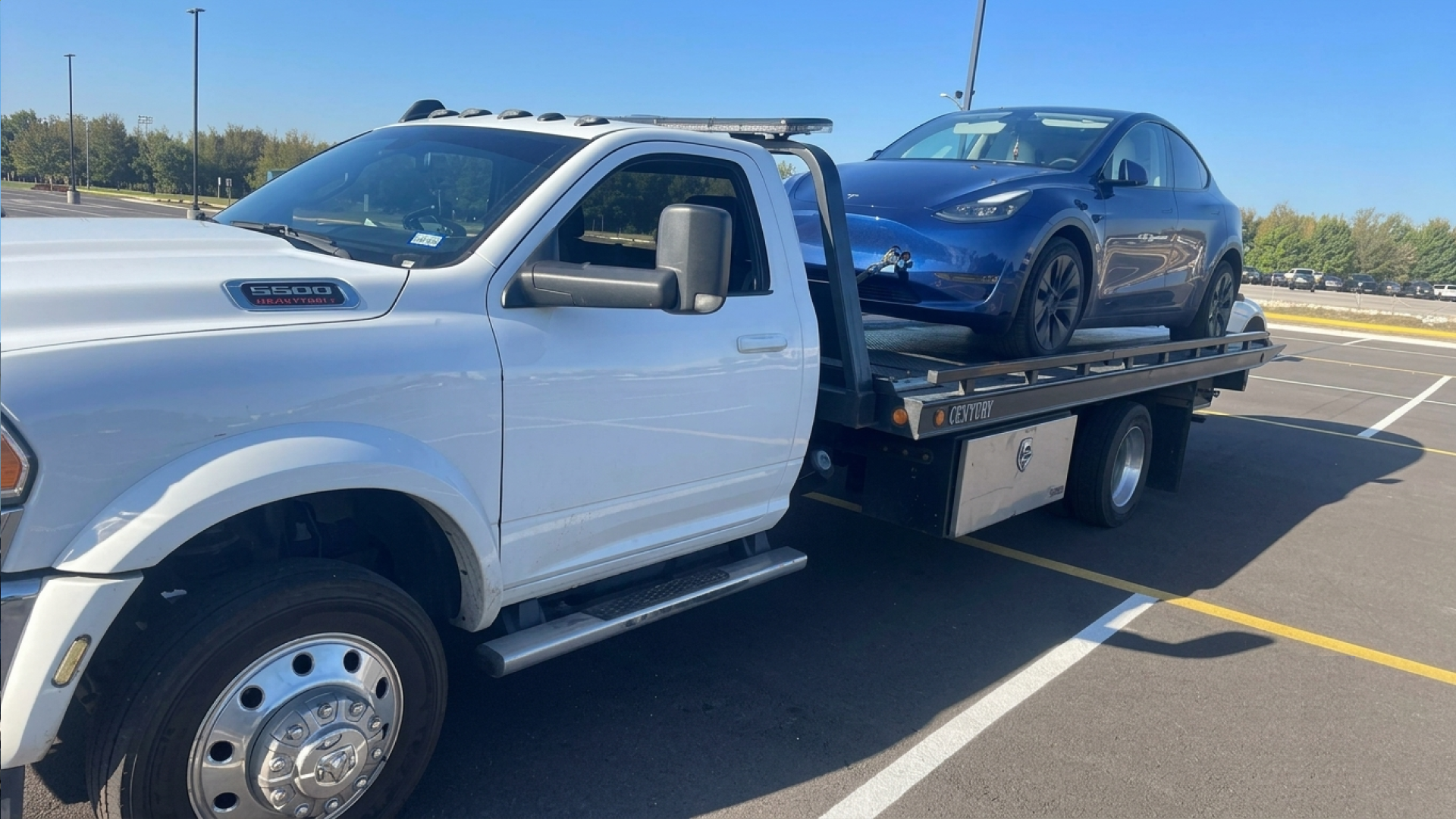
A flatbed towing truck carries the vehicle with all four wheels off the road. This eliminates the need for the vehicle's drive wheels to roll during transportation.
Understanding what is flatbed towing and when is it the safest choice for vehicle transport reveals why flatbed towing can be particularly useful for electric vehicles that cannot safely be moved by allowing their wheels to rotate. Learning how flatbed towing supports safe transport for non-running vehicles can also show why it is a practical choice for vehicles with severe mechanical damage, collision damage, or other conditions that make conventional towing unsuitable.
However, EV owners should still follow their manufacturer's instructions. Discovering the benefits of choosing flatbed towing for accident-damaged vehicles helps drivers understand why a flatbed is ideal, even though it does not automatically eliminate every towing consideration.
Wheel-Lift Towing Requires More Care
Wheel-lift towing raises part of the vehicle while the remaining wheels stay on the road. Depending on the EV's drivetrain and manufacturer instructions, this may or may not be an appropriate method.
If you are unsure, tell the towing provider that the vehicle is electric and provide the exact make and model. The operator can then determine what equipment and procedure are appropriate.
Do not assume that a method used successfully on a conventional front-wheel-drive or rear-wheel-drive vehicle is automatically safe for an EV.
Know Your EV Before You Need a Tow
The best time to learn your vehicle's towing requirements is before you are sitting on the shoulder of a highway.
Spend a few minutes reviewing the relevant sections of your owner's manual. Look for terms such as "towing," "transporting a disabled vehicle," "emergency towing," "vehicle recovery," and "flatbed."
Find Out How Your Vehicle Should Be Moved
Write down or save the manufacturer's recommended towing method. If the manufacturer specifies that the vehicle should be transported with all four wheels off the ground, knowing this ahead of time can make an emergency call much more productive.
You should also know whether your EV has specific procedures for:
Releasing the parking brake
Selecting neutral
Disabling certain vehicle systems
Using designated recovery points
Loading the vehicle onto a flatbed
Handling a vehicle with a depleted 12-volt battery
Transporting a damaged or accident-involved EV
Know Where the Recovery Points Are
Many vehicles have designated recovery points or towing eyes. These locations are not interchangeable with random suspension or body components.
Your owner's manual can show where the manufacturer-approved recovery point is located and whether a special attachment or cover needs to be removed.
Knowing this information can save time during roadside assistance and reduce the risk of attaching equipment to an inappropriate part of the vehicle.
What EV Owners Should Tell the Towing Company
Clear information can help the towing provider arrive with appropriate equipment.
When requesting roadside assistance, tell the dispatcher that the vehicle is an EV. Provide the make, model, and model year if you know them.
Also explain what happened.
For example, say whether the vehicle:
Has a flat tire
Will not start or power on
Has a dead 12-volt battery
Has run out of usable charge
Was involved in an accident
Has visible wheel or suspension damage
Is stuck in mud, sand, or another difficult location
Is parked in a garage or confined area
These details can affect the equipment and approach needed to move the vehicle.
Tell the Operator About Accident Damage
An EV involved in a collision requires additional care. Damage may not always be obvious from the outside, and an accident can affect the battery enclosure, electrical systems, suspension, steering, or underbody.
If the vehicle has been in a significant crash, do not attempt to move it unnecessarily. Tell the towing provider about the accident and any visible damage so the recovery can be planned appropriately.
Common EV Roadside Problems That May Require Towing
Not every EV roadside emergency is caused by a depleted traction battery. Knowing the most common causes of roadside breakdowns and available assistance options can help you prepare for unexpected failures.
A Dead 12-Volt Battery
A weak or discharged 12-volt battery can prevent an EV from starting normally or shifting into the required position for movement. Understanding common reasons drivers need a jump start and how to avoid being stranded is crucial because a dead low-voltage battery can lock up controls.
Depending on the vehicle, roadside assistance may provide jump starts to address the 12-volt issue. However, procedures vary between manufacturers, so owners should avoid experimenting with electrical connections unless the manufacturer specifically provides instructions for doing so.
Flat Tires
Electric vehicles still experience tire punctures and tire damage.
Some EVs do not come with a traditional spare tire, which can make a tire change service particularly useful. Reviewing how professional tire change services improve roadside safety demonstrates why professional help is safer, especially considering tire change services: when roadside assistance is the safer option. If the tire cannot be safely repaired or inflated, the vehicle may need to be transported.
Because EVs can be heavier than comparable gasoline vehicles, using appropriate lifting and loading equipment is particularly important.
Running Out of Charge
Running out of usable battery charge is different from running out of gasoline, where you could rely on an emergency fuel delivery.
Some roadside providers may offer EV charging assistance, while others may recommend transportation to an appropriate charging location. The available solution depends on the service provider, vehicle, location, and circumstances.
If charging assistance is unavailable or unsuitable, towing may be necessary.
Collision or Underbody Damage
An accident can create a towing situation that is more complicated than a normal breakdown. Knowing signs you need professional towing instead of driving a damaged vehicle can protect your high-voltage components.
If the vehicle has damaged wheels, steering components, suspension parts, or possible underbody damage, specialized accident recovery service equipment may be required. Reviewing accident recovery services explained: what drivers need to know after a collision and learning what to expect during a professional accident recovery service call can guide your decisions. Knowing accident recovery vs standard towing: understanding the difference helps ensure the safest approach, which is to avoid forcing the vehicle to move under its own power.
What to Do If Your EV Breaks Down on a DFW Road
A disabled EV on a busy Dallas-Fort Worth road can create immediate safety concerns. Knowing what to do when your vehicle breaks down on a busy DFW road can keep you safe while you handle the issue.
Step 1: Get to a Safe Location
If the vehicle can be moved safely without causing further damage, get as far away from moving traffic as possible. Turn on your hazard lights.
If the vehicle cannot move, or if you need to know what to do if your car breaks down in an unsafe location, remain aware of surrounding traffic and follow local emergency guidance.
Step 2: Assess the Situation
Determine what happened without attempting unnecessary repairs. Consider how weather conditions can affect a vehicle breakdown response as you evaluate the scenario.
Is the vehicle completely unresponsive? Is there a tire problem? Did the vehicle lose power? Was there an accident? Are there warning messages on the dashboard? Knowing what happens if your car won't start in a parking lot helps narrow down the cause.
That information can help the roadside provider understand what type of assistance may be required.
Step 3: Contact Roadside Assistance
Tell the provider that the vehicle is electric. Contact Infront Towing through our contact page or call directly. Give your exact location, vehicle information, and a short description of the problem.
If you know that the manufacturer recommends flatbed transportation, mention that as well.
Step 4: Follow the Manufacturer's Instructions
Avoid improvising towing procedures. Learn how to prepare your vehicle for a scheduled tow and make sure you know what should you remove from your car before it is towed.
An EV's owner manual may contain specific instructions for shifting into neutral, releasing the parking brake, accessing recovery points, or preparing the vehicle for transportation.
Step 5: Verify the Vehicle Is Loaded Correctly
Before transportation begins, make sure the operator understands that it is an EV and follows the appropriate loading and securing procedure.
This is especially important after a collision or when the vehicle has damaged wheels or suspension components.
EV Towing Myths Owners Should Avoid
Several assumptions about towing can cause confusion during an emergency.
Myth: Every EV Can Be Towed Like a Gasoline Car
Not necessarily. Towing requirements vary by vehicle, so the manufacturer's instructions should determine the appropriate method.
Myth: A Dead EV Battery Means the Vehicle Has No Electrical Power
Not always. The main traction battery and 12-volt electrical system serve different purposes. A problem with one does not necessarily mean the other is depleted.
Myth: Neutral Means the Vehicle Can Be Towed Any Way
Selecting neutral does not automatically make every towing method safe. Some drivers ask can a tow truck move a car with a locked steering wheel or can towing services transport a car with no keys, and the answer often depends on specific speed, distance, or wheel-position requirements for emergency movement.
Myth: Any Tow Truck Can Handle Any EV
Towing providers use different equipment and procedures. Sharing the vehicle's make and model before dispatch gives the provider a better opportunity to send appropriate equipment.
How to Prepare for an EV Towing Emergency
A small amount of preparation can make a roadside emergency less stressful. Knowing what to keep in your car for a roadside emergency is essential for any EV driver.
Keep these details accessible:
Vehicle make, model, and model year
Manufacturer towing instructions
Roadside assistance contact information
Insurance information
Preferred repair facility, if applicable
Vehicle location-sharing capability
Information about the vehicle's charging status
It is also worth checking your insurance policy or roadside assistance membership to understand what types of services are included. You can learn more about about our team and check our towing FAQs for further details.
Keep Charging Habits in Mind
EV owners should plan charging around their normal driving patterns, especially when traveling longer distances where long-distance towing might become a factor if plans fall through. Understanding long-distance towing vs local towing: which service do you need, why long distance towing requires specialized equipment and experience, why vehicle owners choose professional long distance towing services, and long distance vehicle transport: key questions drivers often ask can save you hassle during interstate trips.
A low battery does not necessarily mean an emergency, but consistently driving until the vehicle reaches extremely low charge can leave you with fewer options if traffic, weather, construction, or an unexpected detour changes your plans.
For DFW drivers, long commutes between cities and suburbs can make practical range planning particularly useful.
Why Professional EV Towing Matters
A professional towing provider does more than move a vehicle from one location to another. Learning how flatbed towing helps reduce vehicle wear during transportation emphasizes why proper techniques matter. The operator needs to understand how to position, load, secure, and transport the vehicle without creating additional problems.
For EV owners, that knowledge becomes even more relevant because electric drivetrains and battery systems have different requirements from conventional vehicles.
A reputable provider should take the vehicle's condition seriously, ask useful questions, and use equipment appropriate for the situation.
This same principle applies to motorcycle towing, specialty vehicles, accident-damaged cars, and long-distance transportation. Understanding how professional motorcycle towing protects your bike during transport, avoiding motorcycle towing mistakes that can cause damage to your bike, and learning how motorcycle owners can prepare for emergency towing situations highlights the importance of specialty equipment. Similarly, services like show car hauling demonstrate why flatbed towing is recommended for luxury and specialty vehicles, show car hauling: how professional transport helps protect valuable vehicles, and why show car hauling is different from standard vehicle towing. The right equipment and preparation can make the difference between a straightforward recovery and additional vehicle damage.
Key Takeaways for EV Owners
You do not need to memorize every technical detail about your electric vehicle. You do need to know the basics.
Before an emergency happens, learn:
Whether your EV requires flatbed transportation
How the manufacturer recommends moving a disabled vehicle
Where the approved recovery points are located
How the vehicle handles a 12-volt battery failure
What to do after an accident
Who to call for roadside assistance
What information the towing provider will need
When requesting assistance, always identify the vehicle as an EV and provide its exact make and model.
That simple step can help the towing provider determine what equipment and procedure are appropriate for your situation.
Conclusion
Electric vehicles offer a different driving experience, and their towing requirements deserve the same attention as charging, tire care, and routine maintenance. An EV should not automatically be treated like a conventional gasoline-powered vehicle when it needs roadside assistance.
The most useful preparation is straightforward: read your owner's manual, understand the manufacturer's towing instructions, know where the recovery points are, and tell the towing provider that you drive an EV.
If your vehicle breaks down, has a flat tire, becomes involved in an accident, or needs transportation for another reason, avoid guessing about the correct towing method. Professional roadside assistance and appropriate towing equipment can help get the vehicle moved safely and according to its requirements.
For EV owners across the Dallas-Fort Worth area, knowing these details before an emergency occurs can make an unexpected roadside problem considerably easier to handle, whether you find yourself facing emergency roadside situations that often require professional towing assistance or just a simple flat.
Frequently Asked Questions
What is the safest way to tow an electric vehicle?
The safest towing method depends on the EV's make, model, drivetrain, and manufacturer instructions. Many EVs are transported on a flatbed so that all four wheels remain off the road, but owners should always follow the specific towing guidance provided by the manufacturer.
Can an electric vehicle be towed with two wheels on the ground?
It depends on the vehicle. Some EVs may have restrictions against allowing their drive wheels to rotate during towing. Check the owner's manual before using wheel-lift or other towing methods, and tell the towing provider the exact vehicle model.
Can a dead EV battery be recharged by a tow truck?
Some roadside assistance providers offer mobile EV charging, but availability varies by provider and location. If mobile charging is unavailable or unsuitable, the vehicle may need to be transported to a charging station or another appropriate location.
Can an EV be towed after an accident?
Yes, but accident-damaged EVs may require additional precautions. Damage to the wheels, suspension, underbody, or high-voltage battery area can affect how the vehicle should be moved. Tell the towing provider about the collision and visible damage before recovery begins.
What happens if an EV has a dead 12-volt battery?
A dead 12-volt battery can prevent some EVs from powering up normally even when the main traction battery has charge. The correct procedure varies by manufacturer, so owners should follow the vehicle's instructions or contact qualified roadside assistance rather than improvising electrical connections.
Do electric vehicles need special tow trucks?
Not necessarily a completely different type of tow truck, but the vehicle may require specific equipment or procedures. Flatbed trucks are commonly useful for vehicles that need all wheels off the ground. The towing provider should know the EV's make and model before dispatch.
Can a towing company transport an EV long distance?
Yes. Electric vehicles can be transported over long distances, provided the towing equipment and loading procedure are appropriate for that specific vehicle. Before arranging long-distance towing, confirm the vehicle's manufacturer requirements and communicate them to the provider.
Can an EV be pulled out if it is stuck in mud or sand?
Recovery from mud, sand, or another difficult surface may require specialized equipment and careful use of the manufacturer's designated recovery points. Avoid attaching recovery equipment to an unsuitable suspension or body component. Professional vehicle recovery is often the better option when the vehicle is deeply stuck.
What should I tell a towing company when my EV breaks down?
Provide your exact location, vehicle make and model, model year if known, the nature of the problem, and whether the vehicle was involved in an accident. Mention whether it has a flat tire, dead 12-volt battery, depleted traction battery, wheel damage, or other visible problems.
Should I keep my EV owner's manual available during a roadside emergency?
Yes. The towing section can provide useful information about approved recovery points, loading procedures, neutral mode, parking-brake requirements, and other transportation instructions. Keeping a digital copy accessible on your phone can be helpful if the printed manual is not available.
