

A Driver’s Guide to Getting Reliable Towing Help in DFW
Introduction
A vehicle breakdown can turn an ordinary drive through Dallas-Fort Worth into a stressful situation within minutes. Your engine might stop working on a busy highway, a flat tire could leave you stranded near an unfamiliar exit, or an accident might make your car unsafe to drive. In these moments, finding reliable towing help in DFW is about more than getting a truck to your location. It means protecting yourself, understanding your options, and making an informed decision about who handles your vehicle.
The Dallas-Fort Worth area presents a variety of driving challenges. Drivers travel on busy highways such as I-35E, I-35W, I-20, I-30, and I-635, along with crowded local roads, frontage roads, and suburban streets. Heavy traffic, construction zones, changing weather, and long commutes can make a breakdown especially difficult to manage.
Knowing what to do before an emergency occurs can help you respond calmly. You should understand when roadside assistance may be enough, when professional towing is necessary, which towing method suits your vehicle, and what to ask before authorizing a service.
This guide explains how to find dependable towing assistance in the Dallas-Fort Worth area, what to expect during the process, and how to protect your vehicle from unnecessary damage or confusion. You can also explore insights on how to choose a towing company in the DFW metroplex for more details.
What Makes a Towing Service Reliable in DFW?
A reliable towing service does more than transport a disabled vehicle. It communicates clearly, uses appropriate equipment, follows safe loading practices, and explains the service before work begins.
Not every towing situation requires the same truck or level of assistance. A car with a dead battery may need a jump-start, while a vehicle with collision damage might require a flatbed towing and careful handling.
Clear Communication and Accurate Arrival Estimates
A dependable towing provider should ask useful questions before dispatching a truck. These may include your exact location, vehicle type, current condition, and whether your vehicle is blocking traffic.
When requesting assistance, provide the following information:
Your highway, road, nearest exit, or recognizable landmark.
Your direction of travel and the nearest cross street, if applicable.
Your vehicle's make, model, and approximate size.
The problem preventing you from driving safely.
Any special circumstances, such as collision damage, a locked steering wheel, or a vehicle stuck off the pavement.
Accurate information helps the dispatcher determine which equipment may be needed. Ask for an estimated arrival time and instructions for staying safe while waiting. To learn more about this step, read about what information should you give a towing company when you call.
An estimate is not a guarantee. Traffic congestion, road closures, weather, and other active calls can affect arrival times. Reliable communication means receiving updates when circumstances change.
Transparent Pricing Before Service Begins
Towing costs can vary significantly depending on distance, vehicle size, equipment requirements, recovery difficulty, and time of service. A straightforward tow from a parking lot may cost less than recovering a vehicle from a ditch after an accident.
Before approving the service, ask for an estimated total and clarify what it includes. Depending on the situation, charges may cover a base hookup fee, mileage, winching, specialized equipment, after-hours service, or storage-related arrangements.
Ask whether additional charges could apply if the vehicle is difficult to access or requires a different truck. Request an explanation of any fees you do not understand.
A professional provider should explain the pricing structure before proceeding whenever circumstances allow. If the initial estimate changes, ask why and approve the revised amount before additional work begins.
Appropriate Equipment and Safe Handling
The right equipment matters because vehicles differ in weight, ground clearance, drivetrain configuration, and towing requirements.
A compact sedan, a low-clearance sports car, an all-wheel-drive SUV, and a motorcycle cannot always be handled in the same way. A reliable operator considers these differences before loading the vehicle.
Ask whether the company can accommodate your specific vehicle and situation. If your car has collision damage, modified suspension, electric powertrain components, or other special requirements, mention them before dispatch.
What Should You Do Before Calling for a Tow Truck?
Your first priority during a breakdown is personal safety, not arranging transportation for the vehicle. The safest response depends on where the vehicle stops and whether it can move without creating additional danger.
Step 1: Move to a Safer Location If Possible
If your vehicle begins experiencing trouble, activate your hazard lights and assess whether you can reach a safer location without putting yourself or other road users at risk.
If the vehicle still responds normally, you may be able to move toward a designated shoulder, nearby parking area, or other safe location. Do not attempt to drive a vehicle with serious brake problems, severe steering issues, smoke, or other signs of a potentially dangerous mechanical failure.
If the car stops in an active traffic lane, do not put yourself in danger trying to push it. Follow emergency guidance and contact 911 if the situation creates an immediate hazard. For guidance on tricky spots, review what to do when your vehicle breaks down on a busy DFW road.
Step 2: Assess Your Surroundings
Once stopped, look at the surrounding traffic and road conditions before deciding what to do next.
On a busy DFW highway, standing outside beside the vehicle may expose you to passing traffic. If the vehicle is in a dangerous location, follow the guidance of emergency personnel and local authorities rather than attempting an unsafe exit.
If you can safely move away from traffic, do so carefully. Avoid standing behind or directly in front of the vehicle, and never attempt roadside repairs in an exposed traffic lane.
Step 3: Identify the Problem Without Attempting Risky Repairs
You do not need to diagnose every mechanical issue before calling for help. However, describing the symptoms can help the dispatcher select an appropriate service.
For example:
A clicking sound when starting may indicate a battery or electrical problem.
A tire that has lost pressure may require roadside tire assistance or towing.
Rising engine temperature may indicate an overheating problem.
Smoke, fluid leaks, or unusual burning smells may signal a more serious issue.
Collision damage, a jammed wheel, or a vehicle that will not roll may require specialized towing or recovery.
These symptoms are clues, not definitive diagnoses. If you suspect a serious mechanical problem, avoid repeatedly restarting the engine or attempting to drive the vehicle.
Step 4: Contact a Suitable Towing or Roadside Assistance Provider
Explain your location and symptoms clearly. If you are unsure whether you need a repair at the roadside or a tow to a shop, describe the situation and ask which service is appropriate.
You should also explain any unusual circumstances, such as a vehicle in a ditch, a damaged axle, an inaccessible parking garage, or a car that cannot shift into neutral.
Clear details reduce the chance of dispatching equipment that cannot safely handle the job.
Roadside Assistance vs. Towing: Which Service Do You Need?
Roadside assistance provides help with certain problems that may be resolved without transporting the vehicle. Towing moves a vehicle to another location when driving it is unsafe, impossible, or impractical.
Understanding the difference can save time and help you request the right service.
When Roadside Assistance May Be Enough
Roadside assistance may be suitable for relatively straightforward problems, including:
A discharged battery that can be safely jump-starts.
A flat tire that can be changed safely via tire change service.
An empty fuel tank that requires emergency fuel delivery.
A vehicle lockout that can be resolved using appropriate entry methods.
The appropriate solution depends on the vehicle and the specific problem. For example, a jump-start may restore power, but it will not resolve an underlying alternator failure or another electrical fault.
Similarly, a tire change may not be possible if the wheel is damaged, the lug nuts cannot be removed safely, or the vehicle is stopped in a dangerous location.
When Professional Towing Is the Better Choice
Towing is generally appropriate when the vehicle cannot be driven safely or a roadside repair is not feasible.
Common reasons include engine failure, major collision damage, serious steering or brake problems, severe overheating, damaged suspension, and certain transmission or drivetrain issues.
A tow may also be the sensible option when the vehicle repeatedly stalls or develops a warning condition that makes continued driving unsafe.
Do not assume a vehicle is safe to drive simply because the engine starts. If critical systems may be damaged, arrange an appropriate inspection or transport instead.
Understanding Different Towing Methods
The towing method should match the vehicle's condition, manufacturer requirements, and transport needs. Asking the right questions before dispatch helps prevent avoidable complications.
Flatbed Towing
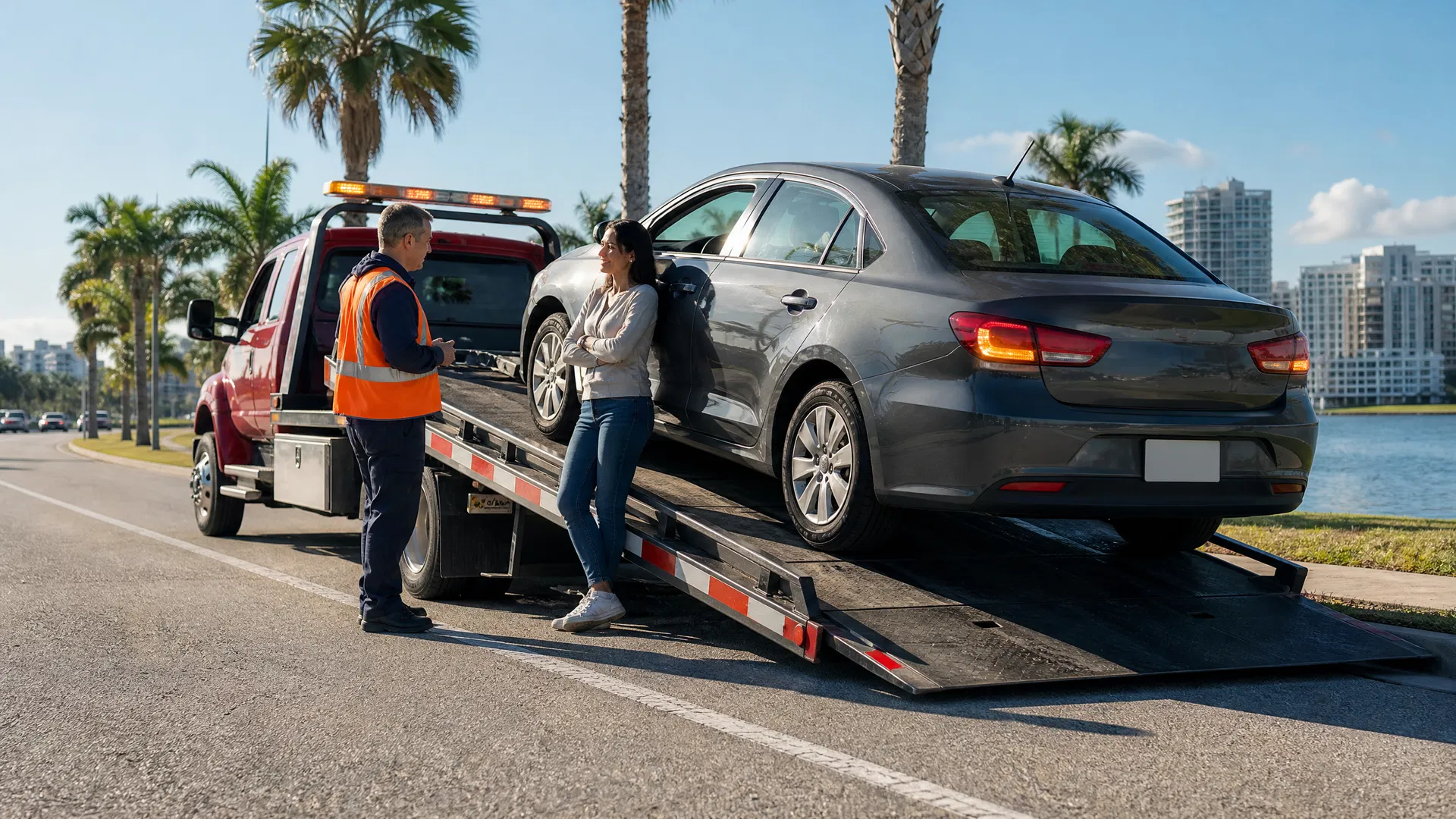
Flatbed towing uses a truck with a platform that lowers so the vehicle can be loaded onto it. The vehicle is then secured on the platform for transport.
This method is often suitable for:
Vehicles with significant collision damage.
Many all-wheel-drive vehicles when the manufacturer's towing instructions require all wheels off the road.
Low-clearance or specialty vehicles.
Vehicles with certain wheel, suspension, or drivetrain problems.
Motorcycles when the truck and securing equipment are appropriate.
Flatbed transport keeps the vehicle's wheels off the road during transit. However, loading still requires proper clearance, securement, and attention to existing damage.
If you drive an electric vehicle, consult its manufacturer-specific towing instructions. Some EVs require flatbed transport or other precautions to protect the drive system. You can learn more about this via towing for electric vehicles what owners should know.
Wheel-Lift Towing
Wheel-lift towing uses a lifting mechanism to raise one end of the vehicle while the other end remains on the road.
It can be appropriate for certain conventional vehicles and situations, provided the vehicle's drivetrain, transmission, steering, and manufacturer instructions permit the method.
Wheel-lift towing is not automatically suitable for every vehicle. All-wheel-drive systems, damaged wheels, low ground clearance, and other mechanical conditions may require a different approach.
Winching and Vehicle Recovery
Winching involves using a cable or similar equipment to pull a vehicle from a difficult position. It may be needed when a car is stuck in mud, resting in a ditch, or unable to move after an incident.
Recovery is different from a routine tow because the vehicle may need to be repositioned before it can be loaded. For specialized incidents, an accident recovery service is ideal.
Before recovery begins, the operator should assess the vehicle's position, ground conditions, attachment points, and nearby hazards. A vehicle with collision damage may require additional precautions.
Never attach recovery equipment to an arbitrary part of your vehicle or attempt a complicated recovery using an unsuitable rope or improvised setup.
How to Choose a Towing Company in the Dallas-Fort Worth Area
Finding a towing provider quickly matters during an emergency, but speed should not be your only consideration. A few direct questions can help you assess whether a company is equipped to handle your situation.
Verify Service Coverage and Availability
The DFW region covers a large geographic area, and a provider's operating area may not include every suburb or highway.
Confirm that the company serves your location and can dispatch the appropriate equipment. Ask whether assistance is available at your current time, including overnight, on weekends, and during holidays.
A company advertising 24/7 towing should be able to explain how after-hours dispatch works. Confirm the expected response window rather than assuming a truck is immediately available.
Check Reputation and Business Information
Look for consistent business information, clear contact details, and customer feedback that describes actual service experiences.
Reviews can provide useful clues about communication, billing, vehicle handling, and how a company responds when plans change. Read several reviews rather than basing your decision on one unusually positive or negative comment.
A professional website and an established online presence can help you verify contact information and service offerings, but neither guarantees service quality. Focus on practical evidence and the answers you receive when speaking with the dispatcher.
Key Details to Confirm
Questions to Ask Before Authorizing a Tow
Before confirming service, ask:
Can you tow my vehicle's make, model, and drivetrain configuration?
What is the estimated total cost, including applicable mileage and equipment charges?
What is the expected arrival time?
Where will the vehicle be taken?
Can I request a specific repair shop or destination?
Are there any circumstances that could increase the quoted price?
Will you document existing damage and explain the vehicle securement process?
You may not need every answer for a simple roadside call, but pricing, destination, equipment suitability, and arrival estimates are especially useful.
What to Expect During an Emergency Tow
Knowing the usual process makes it easier to understand what is happening after you request assistance.
Dispatch and Location Confirmation
The dispatcher collects your location, contact details, vehicle information, and description of the problem. You may receive an estimated arrival time and instructions for identifying your vehicle.
If your location is difficult to describe, use a nearby exit number, cross street, business, or recognizable landmark. Share a map location when the provider can receive it.
Vehicle Assessment and Loading
When the operator arrives, explain the symptoms and point out any visible damage or special handling requirements.
The operator should assess the vehicle and select an appropriate loading method. Depending on the vehicle, this may involve a flatbed, wheel-lift equipment, dollies, or recovery equipment.
Before the vehicle is moved, discuss any existing damage and clarify the destination. If practical, take photographs of the vehicle's condition before loading. You can also read about what happens when a tow truck arrives at your location.
Transport and Drop-Off
Confirm the delivery address before the truck leaves. If your vehicle is going to a repair shop, check whether the shop can receive it at that time and whether after-hours drop-off instructions apply.
Remove valuables and personal belongings if you can do so safely. Tell the operator about any special access instructions or concerns regarding the vehicle.
For accident-related towing, insurance requirements and local procedures may affect the destination or release process. Ask questions before authorizing a change in destination or agreeing to storage arrangements.
Towing After a Car Accident in DFW
A collision creates additional concerns because a damaged vehicle may have hidden problems even when the exterior damage looks minor.
First, check for injuries and contact emergency services when necessary. Follow instructions from responding officers and move to safety if you can do so without exposing yourself to additional danger.
Do Not Assume the Vehicle Is Roadworthy
Damage to the steering, suspension, brakes, cooling system, wheels, or electrical components can make a vehicle unsafe to drive. Airbag deployment, fluid leaks, or damaged high-voltage components on an electric vehicle may also require special precautions.
If there is any doubt about the vehicle's condition, request an appropriate tow rather than attempting to drive it. Read more on how to tell if your vehicle is safe to drive after a breakdown.
Understand Insurance and Storage Considerations
Your insurance policy may include towing or roadside assistance benefits, but coverage limits, eligible expenses, and approved procedures vary.
If it is safe to do so, contact your insurer and ask whether it has a preferred claims process or requirements for towing and storage. You can also ask the towing provider for an itemized receipt and documentation of the destination.
Be cautious about authorizing a tow to an unfamiliar storage facility without understanding the potential charges and vehicle-release process. If law enforcement directs the removal of a vehicle, follow applicable instructions and clarify your options as soon as circumstances permit.
How to Prepare for Long-Distance Towing
Long-distance towing may be necessary after a major breakdown, when a vehicle must be transported to a preferred mechanic, or when you need to move a specialty vehicle between cities.
The planning process is slightly different from an ordinary local tow because distance, vehicle requirements, and delivery arrangements have a greater effect on the job.
Confirm the Total Price and Transport Details
Provide both pickup and delivery addresses. Ask whether the estimate includes loading, mileage, recovery work, tolls, and any additional services that may apply.
Clarify the expected pickup and delivery windows. A delivery estimate may be affected by traffic, distance, weather, and other logistical factors.
For a high-value or specialty vehicle, discuss the equipment, loading method, and securement approach before confirming the booking. For example, you might look into motorcycle towing or show car hauling depending on your asset.
Prepare the Vehicle for Transport
Remove personal belongings that are not needed for the trip and secure loose items. Tell the operator if the vehicle has a mechanical issue that affects loading, such as a locked steering system, damaged tires, or an inability to shift into neutral.
Do not attempt to repair or reposition a damaged vehicle simply to make loading easier. Explain the problem so the operator can plan accordingly.
Photograph the vehicle before transport and keep copies of the service authorization, receipt, and any relevant insurance documentation.
Common Mistakes to Avoid When Requesting Towing Help
A few preventable mistakes can make a stressful roadside situation more complicated.
Mistakes to Keep in Mind
Choosing Only by the Lowest Quote
A low initial price does not necessarily represent the total cost. Compare what each estimate includes, especially mileage, recovery work, equipment requirements, and additional fees.
The goal is to find an appropriately equipped provider with clear pricing, not simply the lowest advertised number.
Giving an Incomplete Description of the Problem
Failing to mention collision damage, a stuck vehicle, a low-clearance sports car, or an all-wheel-drive system can lead to the wrong equipment being dispatched.
Describe the situation as accurately as possible. If you do not know what is wrong mechanically, explain the symptoms instead of guessing at a diagnosis.
Ignoring Vehicle Manufacturer Instructions
Some vehicles have specific towing restrictions. Improper towing can damage a transmission, electric drive system, drivetrain, or other components.
Consult the owner's manual when available and tell the towing provider about any relevant requirements. If you cannot access the manual, ask the operator how the vehicle will be transported safely.
Waiting in an Unsafe Location
Drivers sometimes focus on finding a tow truck while overlooking immediate traffic hazards.
If your vehicle is stranded near moving traffic, avoid standing in exposed areas or attempting repairs in an unsafe position. Contact emergency services when the situation creates an immediate danger and follow local instructions.
Conclusion
Getting reliable towing help in DFW starts with making safe decisions, describing your situation clearly, and choosing a service that matches your vehicle's needs. Understanding the difference between roadside assistance, flatbed towing, wheel-lift towing, and vehicle recovery helps you request appropriate help without unnecessary confusion.
Before authorizing a tow, confirm the estimated cost, arrival window, equipment suitability, and destination. After an accident or serious mechanical failure, prioritize safety and avoid driving a vehicle that may be damaged.
Keep a roadside emergency kit, know how to share your location, and save the contact details of a dependable towing provider before you need one. When a breakdown happens, preparation and clear communication can make a difficult situation easier to manage.
Drivers throughout Dallas-Fort Worth can benefit from understanding their options before an emergency occurs. Infront Towing provides 24/7 towing and roadside assistance, including flatbed towing, accident recovery, motorcycle transport, jump-starts, tire changes, fuel delivery, and long-distance towing. When requesting help, explain your vehicle's condition and location so the appropriate service can be discussed. You can check out more tips on choosing the right towing service based on your vehicle and situation, get in touch via the contact page, or learn more about us. For further answers, visit the towing FAQs.
Frequently Asked Questions
What Should I Do If My Car Breaks Down on a DFW Highway?
Turn on your hazard lights and move to a safer location only if you can do so safely. Avoid standing near moving traffic, contact emergency services if an immediate hazard exists, and provide your exact highway location and direction of travel when requesting roadside assistance or towing.
How Much Does a Tow Truck Cost in the Dallas-Fort Worth Area?
Towing prices depend on distance, vehicle type, time of service, equipment requirements, and recovery difficulty. Ask for an estimated total before authorizing service and confirm whether mileage, hookup, winching, and after-hours charges are included.
When Should You Choose Flatbed Towing for Your Vehicle?
Flatbed towing is often appropriate for vehicles with significant collision damage, low ground clearance, certain drivetrain configurations, or special transport requirements. The correct method depends on the manufacturer's instructions and the vehicle's condition.
What Should I Do After a Car Accident If My Vehicle Cannot Be Driven?
Check for injuries, contact emergency services when necessary, and follow instructions from responding authorities. Avoid driving a damaged vehicle, document its condition when safe, and confirm the towing destination and any insurance or storage requirements before authorizing transport.
What Should I Do If My Car Won't Start and I'm Stuck on the Road?
Activate your hazard lights and move to a safe location if possible. Explain the symptoms to a roadside assistance provider. A jump-start may resolve a discharged battery, but repeated starting problems or signs of electrical failure may require towing and mechanical inspection.
How Does 24/7 Emergency Towing Work in the DFW Area?
You contact a towing provider, share your location and vehicle details, and describe the problem. The dispatcher provides an estimated arrival window and arranges suitable equipment. Availability and response times depend on location, traffic, weather, and current demand.
What Is the Difference Between Flatbed Towing and Wheel-Lift Towing?
Flatbed towing places the vehicle on a platform, keeping all wheels off the road during transport. Wheel-lift towing raises one end of the vehicle while the other remains on the road. The appropriate option depends on the vehicle's drivetrain, condition, and towing requirements.
Can a Towing Company Safely Transport a Motorcycle or Specialty Vehicle?
Yes, provided the operator has suitable equipment and experience with the vehicle type. Motorcycle and specialty vehicle transport may require specific loading procedures, securement points, and additional clearance precautions. Explain any special requirements before arranging service.
What Should I Do If I Get a Flat Tire on a Dallas-Fort Worth Road?
Slow down gradually, avoid sudden braking, and move to a safe location if possible. Do not attempt to change a tire beside moving traffic. Request roadside tire assistance or towing if the location is unsafe, the wheel is damaged, or a safe replacement is not possible.
How Does Long-Distance Towing Work, and How Much Does It Cost?
Long-distance towing involves transporting a vehicle between specified pickup and delivery locations. The price depends on distance, vehicle size, loading requirements, and additional services. Request a written or itemized estimate and confirm the transport method, delivery arrangements, and potential extra charges before booking.
