

Can a Tow Truck Transport a Vehicle With Mechanical Damage?
Introduction
A vehicle does not have to be completely wrecked to need a tow. A failed transmission, broken suspension component, damaged axle, overheating engine, steering problem, or electrical failure can leave a vehicle unable to move safely under its own power. In those situations, trying to drive to a repair shop can turn a mechanical problem into a larger and more expensive one.
So, can a tow truck transport a vehicle with mechanical damage? Yes. In many cases, a properly equipped tow truck can safely transport a mechanically damaged vehicle. The right towing method depends on what failed, how the vehicle is positioned, whether the wheels can roll, and whether there is damage underneath the vehicle.
For drivers in the Dallas-Fort Worth area, this distinction matters. A disabled vehicle may be sitting on a busy road, in a driveway, at a parking lot, or on a highway shoulder. The safest towing method is not always the same for every situation.
This guide explains how professional towing companies handle mechanical damage, which towing equipment may be appropriate, what information to provide when requesting service, and what drivers should avoid doing before help arrives.
Can a Tow Truck Move a Vehicle With Mechanical Damage?
Yes, but the towing method must match the vehicle's condition.
Mechanical damage can affect many different components, including the engine, transmission, drivetrain, suspension, steering, brakes, wheels, and axles. Some failures prevent the vehicle from moving at all, while others allow it to roll but make driving unsafe.
A professional towing operator first considers the vehicle's condition before deciding how to load and transport it. You can learn more about assessing vehicle safety after a breakdown in this guide on how to tell if your vehicle is safe to drive after a breakdown.
Common Mechanical Problems That Require Towing
A tow truck may be needed for problems such as:
Transmission failure
Engine failure
Broken axle
Suspension damage
Steering problems
Severe overheating
Failed brakes
Electrical or starting problems
Damaged wheels or tires
Drivetrain problems
Undercarriage damage
A vehicle that has become stuck because of mechanical failure
The key question is not simply whether the engine starts. The operator needs to know whether the vehicle can be safely moved and loaded.
Why Driving a Mechanically Damaged Vehicle Can Be Risky
A vehicle that technically moves may still be unsafe to drive.
For example, a damaged suspension component can affect stability and steering. A transmission problem may cause the vehicle to stop moving unexpectedly. A failing cooling system can lead to severe overheating, while brake problems can make stopping difficult.
If a mechanical issue affects steering, braking, wheels, suspension, or drivetrain components, continuing to drive can create additional damage or increase the risk of a roadside incident. Review the signs you need professional towing instead of driving a damaged vehicle to protect your car from further harm.
How Do Tow Operators Handle Mechanically Damaged Vehicles?
Professional towing involves more than simply attaching a vehicle to a truck and pulling it away.
The operator needs to assess how the vehicle can be moved without creating unnecessary damage. That assessment can include checking whether the wheels roll, whether the vehicle can steer, whether there is clearance underneath it, and whether any components are damaged or loose.
Step 1: Assess the Vehicle's Condition
Before loading the vehicle, the operator may need information about:
What happened to the vehicle
Whether the engine starts
Whether the transmission engages
Whether the wheels roll
Whether the steering works
Whether the brakes function
Whether there is visible suspension or axle damage
Whether the vehicle is sitting normally or at an unusual angle
A vehicle with a simple no-start condition is very different from one with a broken axle or collapsed suspension.
Step 2: Determine the Appropriate Equipment
The condition of the vehicle helps determine which towing equipment is suitable.
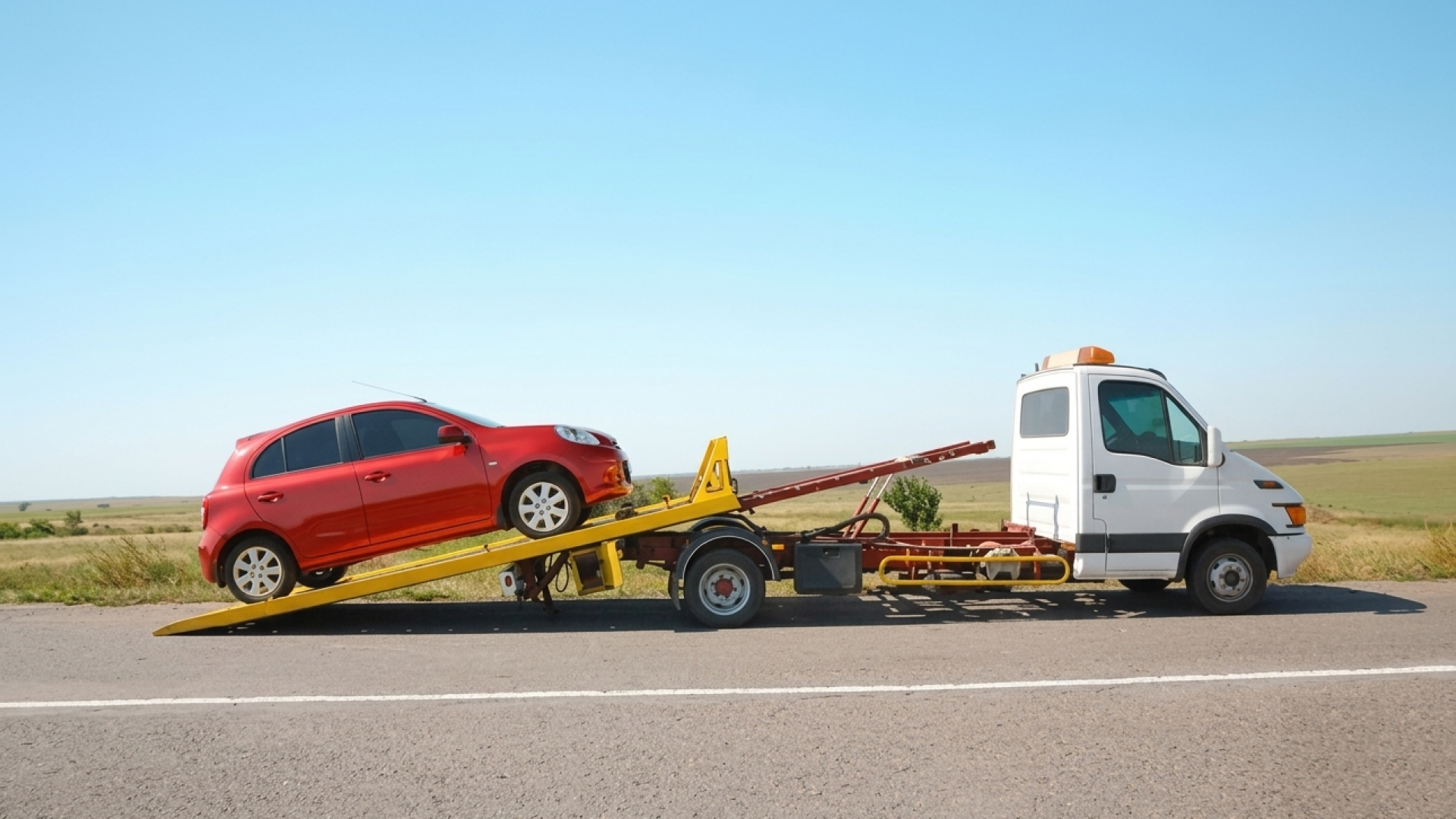
A flatbed towing truck is often useful for vehicles that should not have their wheels turning during transport. A wheel-lift truck may be appropriate for certain vehicles when the vehicle's condition and drivetrain allow it.
For severely damaged vehicles, specialized recovery equipment may be necessary before transportation can begin.
Step 3: Prepare the Vehicle for Loading
The operator positions the towing equipment according to the vehicle's condition.
If the vehicle cannot roll normally, additional equipment or techniques may be required to position it safely. This is particularly relevant when an axle, wheel, suspension component, or steering system has been damaged.
Step 4: Secure the Vehicle
Once loaded, the vehicle must be properly secured for transportation.
The goal is to prevent unwanted movement while the tow truck is traveling. The operator also needs to account for the vehicle's weight, dimensions, condition, and the towing equipment being used.
Step 5: Transport the Vehicle to the Requested Location
The destination may be a repair facility, dealership, residence, body shop, storage facility, or another appropriate location.
For longer trips, the towing provider may need additional information about the vehicle and destination before confirming the service.
When Is Flatbed Towing a Good Choice for Mechanical Damage?
Flatbed towing places the vehicle onto the bed of the tow truck rather than leaving its wheels traveling on the road.
This can be particularly useful when a vehicle should not be driven or rolled for an extended distance. Read more about how flatbed towing supports safe transport for non-running vehicles.
Situations Where Flatbed Towing May Be Appropriate
Flatbed transport may be considered when:
The vehicle has significant drivetrain damage
An axle or suspension component is damaged
The vehicle cannot be driven safely
The vehicle has all-wheel drive or four-wheel drive considerations
The wheels cannot roll normally
The vehicle has specialty requirements
The owner wants the vehicle transported without normal road contact
The appropriate method still depends on the specific vehicle and damage.
Why Flatbed Towing Can Help Protect a Disabled Vehicle
A mechanically damaged vehicle may have components that cannot safely support normal movement.
Keeping the vehicle fully supported on a flatbed can reduce the need for its wheels to roll during transportation. It can also make sense for vehicles where additional precautions are needed because of drivetrain or suspension problems. Discover how flatbed towing helps reduce vehicle wear during transportation.
A professional operator should determine whether a flatbed is appropriate rather than assuming every damaged vehicle requires one.
Can Wheel-Lift Towing Be Used for Mechanical Damage?
Sometimes.
Wheel-lift towing raises one end of the vehicle while the other wheels remain on the road. Whether this method is appropriate depends on the vehicle's drivetrain, the damaged components, and the manufacturer's towing requirements.
A vehicle with certain transmission, drivetrain, steering, or suspension problems may require a different approach.
Why the Damage Location Matters
Consider two vehicles that both have a transmission problem.
One might be safely positioned for a particular towing method, while another could require full vehicle support because of additional damage. The visible symptom alone does not tell the whole story.
This is why describing the mechanical problem accurately when requesting roadside assistance can help the towing company send suitable equipment.
What Information Should You Give the Towing Company?
The more accurately you describe the situation, the easier it is for the towing provider to understand what equipment may be required. Read about what information should you give a towing company when you call.
When calling for a tow, provide:
Vehicle make, model, and approximate year
Your exact location
Your destination
The mechanical problem
Whether the vehicle starts
Whether the vehicle can roll
Whether the steering works
Whether there is visible damage
Whether the vehicle is in a garage, parking area, roadside, or other restricted location
Whether the vehicle has special characteristics, such as all-wheel drive, low ground clearance, or unusual size
If the vehicle is damaged after an accident, say so. Accident recovery can involve different equipment and procedures than a standard mechanical breakdown.
What If You Don't Know What's Wrong?
You do not need to diagnose the vehicle yourself.
Simply describe what you observed. For example, you might say the engine stopped while driving, the vehicle will not move when shifted into gear, there is a loud noise from one wheel, or the vehicle starts but cannot be safely driven.
Avoid guessing that a specific component has failed unless you have already received a diagnosis.
What Should You Do Before the Tow Truck Arrives?
Safety should come before trying to troubleshoot a serious mechanical failure on the roadside.
If the vehicle is in a dangerous location, turn on the hazard lights when possible and move to a safe location if you can do so without exposing yourself to traffic or other hazards.
Avoid Making the Damage Worse
Do not repeatedly attempt to drive a vehicle when there are signs of serious mechanical damage.
Avoid forcing a vehicle to move if the wheels are locked, the suspension is damaged, the steering is compromised, or the drivetrain appears to have failed. A tow operator can determine how the vehicle should be moved.
Tell the Operator About Anything Unusual
Mention problems such as:
A vehicle sitting unusually low
A wheel that is turned at an abnormal angle
Fluid leaking underneath
A broken suspension component
A locked wheel
A vehicle that cannot be shifted into neutral
A vehicle located in a confined space
These details can affect the loading process.
What Are Common Misconceptions About Towing Mechanical Damage?
Mechanical damage does not automatically mean the vehicle cannot be transported.
One common misconception is that a tow truck can only move vehicles that are completely functional except for a dead battery or flat tire. In reality, towing services are commonly used precisely because vehicles cannot safely drive themselves.
Another misconception is that every disabled vehicle can be towed in exactly the same way.
Misconception: If the Engine Starts, I Can Drive It
Not necessarily.
A running engine does not mean the vehicle's steering, braking, suspension, transmission, or drivetrain is safe. If one of those systems has failed, driving may be unsafe even though the engine runs normally.
Misconception: Every Tow Truck Can Handle Every Vehicle
Tow trucks and towing equipment have different capabilities.
Vehicle size, weight, ground clearance, drivetrain, location, and mechanical condition can all affect what equipment is needed. Specialty vehicles and motorcycles may require equipment suited specifically to their configuration.
Misconception: Towing Is Only for Emergencies
Towing can also be used for planned transportation.
A vehicle with mechanical problems may need to be moved from a home to a mechanic. A non-running specialty vehicle may need transport to another facility. Long-distance towing may also be arranged when the destination is outside the immediate service area.
Mechanical Damage vs. Accident Damage
Mechanical and collision damage can overlap, but they are not identical.
A mechanical breakdown may happen without any collision. An accident can damage suspension, steering, wheels, body panels, drivetrain components, or other parts of the vehicle.
The towing approach may change depending on what happened.
Mechanical Breakdown
Examples include:
Engine failure
Transmission failure
Dead battery
Overheating
Broken belt or component
Starting problems
Drivetrain failure
Accident Damage
Examples include:
Collision damage
Bent wheels
Suspension damage
Broken steering components
Vehicle positioned at an unusual angle
Body damage that affects loading
After a collision, it is especially important to tell the towing company that the vehicle has accident damage so the operator can account for its condition. You can also explore professional accident recovery service options.
How Can Drivers Reduce the Risk of Additional Damage During Towing?
The safest approach is to provide accurate information and allow the towing professional to determine the appropriate loading method.
A few practical steps can help:
Describe the mechanical symptoms clearly.
Tell the operator whether the vehicle can roll.
Mention steering or suspension problems.
Identify visible leaks or broken components.
Tell the operator if the vehicle is in a tight or difficult-to-access location.
Remove personal belongings before transport when practical. Learn more about what should you remove from your car before it is towed.
Take photographs of the vehicle's condition before loading if appropriate.
Confirm the destination before the vehicle is transported.
Documentation can be particularly useful when the vehicle has significant damage or when it is being moved after an accident.
How Does Long-Distance Towing Work for a Mechanically Damaged Vehicle?
Long-distance towing can involve additional planning compared with a short trip to a nearby repair shop.
The towing provider may need the vehicle's dimensions, condition, pickup location, destination, and preferred transportation method. A vehicle that cannot safely roll or has significant mechanical damage may require equipment capable of supporting it throughout the trip. Read more about why why long-distance towing requires specialized equipment and experience.
Before arranging long-distance towing, ask about the expected transportation method, pricing structure, pickup requirements, and destination details.
Do not assume that the cheapest transportation method is appropriate for a damaged vehicle. The condition of the vehicle should remain a primary consideration.
Can Specialty Vehicles With Mechanical Problems Be Transported?
Yes, but specialty vehicles may require additional planning.
Motorcycles, classic vehicles, low-clearance vehicles, recreational vehicles, and other specialty vehicles can have different loading and securing requirements. For instance, you can utilize professional motorcycle towing or show car hauling services.
For example, a motorcycle that will not start cannot necessarily be handled in the same way as a standard passenger car. The towing provider may need motorcycle-specific equipment and appropriate tie-down procedures.
Providing accurate information about the vehicle before dispatch helps the operator prepare for the job.
What Should You Look for in a Towing Company?
When selecting roadside assistance or towing service, focus on practical factors rather than choosing a provider based only on a low advertised price.
Look for a company that:
Provides the type of towing you need
Has appropriate equipment for the vehicle
Clearly explains the service
Communicates the expected destination and pricing
Offers roadside assistance when appropriate, such as jump starts, tire change service, or emergency fuel delivery
Can handle accident recovery when necessary
Provides service in your location
Has experience with specialty vehicles when required
For DFW drivers, local familiarity can also matter because towing situations can occur on highways, residential streets, parking lots, and busy commercial roads throughout the Dallas-Fort Worth area. You can find more tips on how to choose a towing company in the DFW metroplex.
Conclusion
A tow truck can transport a vehicle with mechanical damage, but the correct method depends on the nature and location of the damage. Engine failure, transmission problems, broken axles, suspension damage, steering issues, and other mechanical failures can make driving unsafe even when the vehicle still appears capable of moving.
Flatbed towing may be appropriate for vehicles that should remain fully supported during transportation, while wheel-lift towing can be suitable in certain circumstances. The decision should account for the vehicle's condition, drivetrain, wheels, steering, suspension, location, and transportation requirements.
If your vehicle becomes disabled, give the towing provider as much accurate information as possible. Explain what happened, whether the vehicle starts or rolls, and whether you see any obvious damage. That information helps the operator determine how the vehicle can be moved safely and what equipment may be needed.
For DFW drivers, having a plan for mechanical breakdowns can make an already stressful roadside situation easier to manage. When a vehicle cannot safely get to a repair facility under its own power, professional towing provides a way to move it without asking the vehicle to do more than its condition allows.
Frequently Asked Questions
What Should I Do If My Car Breaks Down on a DFW Highway?
Turn on your hazard lights, move to a safer location if you can do so safely, and request roadside assistance. Tell the towing provider your exact location and explain whether the vehicle can move, steer, and start. Read more about what to do when your vehicle breaks down on a busy DFW road.
How Much Does a Tow Truck Cost in the Dallas-Fort Worth Area?
Towing prices vary based on factors such as distance, vehicle type, location, towing method, time, and the service required. Ask for pricing details before service when possible, especially for long-distance transportation.
When Should You Choose Flatbed Towing for Your Vehicle?
Flatbed towing can be useful when a vehicle should not have its wheels rolling during transport, including some vehicles with drivetrain, suspension, axle, or other mechanical problems. The towing operator can determine whether a flatbed is appropriate.
What Should I Do After a Car Accident If My Vehicle Cannot Be Driven?
Move to a safe location if possible, contact emergency services when necessary, and arrange professional towing. Tell the towing provider that the vehicle has accident damage and describe any visible wheel, suspension, steering, or undercarriage problems.
What Should I Do If My Car Won't Start and I'm Stuck on the Road?
Turn on your hazard lights and assess your surroundings before attempting further troubleshooting. If a jump start or other roadside service does not resolve the issue, request towing and explain what happened before the vehicle stopped working.
How Does 24/7 Emergency Towing Work in the DFW Area?
24/7 towing provides access to towing and roadside assistance outside normal business hours. When requesting service, provide your location, vehicle information, problem description, and destination so the appropriate assistance can be arranged.
What Is the Difference Between Flatbed Towing and Wheel-Lift Towing?
A flatbed truck carries the vehicle on a platform, while a wheel-lift system raises part of the vehicle and allows the other wheels to remain on the road. The vehicle's condition and drivetrain help determine which method is appropriate.
Can a Towing Company Safely Transport a Motorcycle or Specialty Vehicle?
Yes, but specialty vehicles may require equipment and loading procedures designed for their configuration. Tell the towing provider what type of vehicle you have and describe any mechanical or physical damage before service is dispatched.
What Should I Do If I Get a Flat Tire on a Dallas-Fort Worth Road?
Move away from traffic if it is safe to do so and turn on your hazard lights. If you cannot safely change the tire or do not have the necessary equipment, roadside assistance may be able to provide a tire change or tow the vehicle.
How Does Long-Distance Towing Work, and How Much Does It Cost?
Long-distance towing involves transporting a vehicle beyond a local towing distance to a specified destination. Cost depends on factors such as mileage, vehicle type, condition, equipment, pickup location, and destination, so request a quote based on your specific situation.
